


Can I wear earbuds instead of ear protection while running a chainsaw?
No. Standard music earbuds are not hearing protection and should never replace rated earmuffs or earplugs while running a chainsaw. They lack a tested Noise Reduction Rating, seal unreliably, and encourage you to turn the volume up to beat the saw — adding a second source of harmful noise.
Why earbuds fail as hearing protection
Regular earbuds are designed to deliver sound to your ear, not to block it. Even noise-isolating or noise-cancelling models are not certified to any hearing-protection standard, so their real attenuation against a 115 dB saw is unknown and inconsistent. The bigger hazard is behavioural: to hear music over a chainsaw, people crank the volume well past 85 dB, so the very device meant to entertain becomes a second cause of noise-induced hearing loss.
What about noise-cancelling or noise-isolating earbuds?
Even active noise-cancelling and snug noise-isolating earbuds are not certified hearing protection and should not stand in for rated muffs or plugs around a chainsaw. Their attenuation is untested against tool noise, inconsistent from fit to fit, and often weakest exactly where a saw is loudest.
Active noise cancellation is tuned to cancel steady, low-frequency drones such as an aircraft cabin, and it does little against the sharp, high-frequency, constantly changing noise of a two-stroke saw. Passive isolating tips block some sound, but with no Noise Reduction Rating you have no verified figure to compare against 85 dBA, and the seal shifts every time the bud moves. None of these are tested to a hearing-protection standard, so none can be trusted the way an NRR-rated device can.
The volume trap, with a worked example
The real danger of earbuds is behavioural: to hear audio over the saw, you raise the volume until the music itself becomes a second hazard stacked on the tool noise. Picture cutting next to a 110 dB saw and pushing your earbuds past it just to follow a podcast.
To stay intelligible over background noise, audio generally has to sit noticeably above it — so overcoming a saw can drive earbud output well past 90 dB straight into your ear canal, on top of whatever tool noise leaks past the bud. You end up damaging your hearing from two directions at once. A rated muff or plug does the opposite: it lowers the tool noise so nothing has to shout over it.
Do bone-conduction or two-way radio headsets count?
Bone-conduction headsets leave your ear canals open, so they provide no hearing protection at all and are a poor choice under a saw. Purpose-built two-way radio or comms headsets can be fine, but only if they carry a valid Noise Reduction Rating on the muff shell.
Bone-conduction devices sit on the cheekbone and rely on open ears, which is the opposite of what you need near loud tools. Genuine comms muffs — the kind used on worksites and ranges — combine a rated passive shell with a microphone and speaker, so they protect while letting you talk; the ISOtunes-style volume-limited safety muffs work on the same principle. Always confirm the NRR before trusting any headset around a chainsaw. The same caution applies to open-ear sport headphones and to hearing aids: neither blocks tool noise, and a hearing aid may even amplify it, so switch hearing aids off and fit rated protection over them. If you genuinely need audio while cutting, the only safe route is a purpose-built, volume-limited Bluetooth safety muff with a published NRR — never a consumer earbud pressed into service. When in doubt, ask whether the device carries a hearing-protection rating; if it does not, it is entertainment, not protection, and it belongs in your pocket while the saw is running.
The safe alternative if you want audio
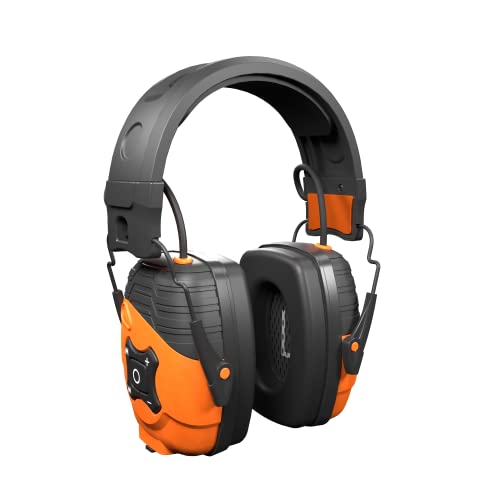
If you want music, calls or podcasts while you cut, use purpose-built Bluetooth safety earmuffs such as the ISOtunes LINK 2.0. These combine a rated passive seal (around NRR 25) with volume limiting that caps output near 85 dB, so the audio itself cannot become the hazard. That gives you the convenience of earbuds with genuine, certified protection — see our best hearing and eye protection picks. For pure quiet, a passive muff or foam plugs remains the cheapest reliable choice.

