


What NRR do I need for a chainsaw?
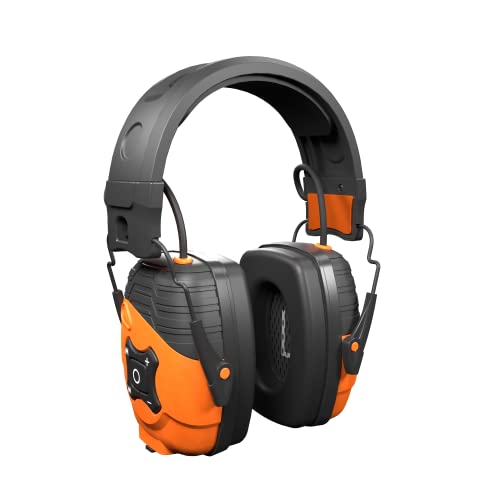
The NRR you need for a chainsaw is one that survives real-world derating and still drops your exposure below 85 dBA. Since a gas saw sits around 106 to 120 dB at the operator's ear, target a labeled NRR in the low-30s for foam earplugs or 30 to 31 for earmuffs.
Why you cannot use the label number directly
NRR is measured in an ideal laboratory with a perfect seal, so field performance is always lower. NIOSH suggests derating the printed number by 25% for earmuffs, 50% for formable foam earplugs, and 30% for other plugs. OSHA's simpler estimate subtracts 7 from the NRR and halves the result. Either way, a 30 dB muff realistically delivers closer to 20 to 22 dB once fit is accounted for — which is still plenty to bring a 115 dB saw down to a safe level, provided the seal is good.
A worked example: taking a loud saw to a safe level
A well-sealed NRR 31 muff brings a saw measured around 110 dB at the ear down to roughly 87 dBA, and adding foam earplugs underneath reaches the low 80s — just under the 85 dBA line. The math shows why the loudest saws want that extra layer.
Work it through: after NIOSH's 25% earmuff derate, an NRR 31 muff realistically delivers about 23 dB, so 110 dB becomes about 87 dBA — right at the edge of safe. That single muff has already removed the great majority of the risk, but 87 dBA still sits just above 85, which is why big-saw felling and all-day chipping justify dual protection for roughly 5 dB more. By contrast, a quieter battery chainsaw near 95 dB with an NRR 25 muff derates to about 76 dBA on its own — no doubling-up needed. Compare the derated figure, never the label, against 85 dBA.
Does wearing plugs under muffs add both ratings together?
No. Combining earplugs and earmuffs does not add their NRRs — real-world dual protection gains only about 5 dB over whichever device is better on its own. An NRR 31 muff over NRR 33 plugs does not give you 64 dB of protection.
The physics sets the limit: once you have sealed the ear canal well, sound also reaches the inner ear by conducting through the skull, so stacking more attenuation over the ears yields diminishing returns. That 5 dB is still worth having for felling with a big saw or a full day of chipping, and it provides a margin when a muff seal is briefly broken by glasses arms or a helmet brim — but treat it as a modest top-up, not a doubling.
What if you cannot get a good seal?
If you cannot seal a muff or plug, its printed rating is meaningless, so fixing fit comes before chasing a higher number. A gap from glasses arms, long hair, a helmet brim or the wrong plug size leaks exactly the high-frequency noise a saw produces.
Try thinner-armed safety glasses, sweep hair clear of the cushions, or switch plug sizes and styles until one seals — many brands sell small, medium and large foam and flanged plugs. If your voice does not sound deep and muffled when you talk, the seal is failing. When nothing seals reliably, a foam plug rolled thin and inserted deep is usually more forgiving than a muff fighting a helmet, and dual protection covers the gap on the loudest jobs. As a rule of thumb, if a muff will not seal over your glasses and helmet, drop to a well-fitted foam plug rather than accept a leaking cup — a sealed NRR 29 plug outperforms a gapping NRR 33 muff every time.
Matching the rating to the tool
The louder the tool, the more headroom you want. For a petrol chainsaw or a wood chipper, a high-NRR muff or plug is worth it; for a quieter battery chainsaw around 90 to 100 dB, a mid-20s NRR is usually enough. For the loudest, longest jobs, wearing foam plugs under muffs adds roughly 5 dB more. Whatever you choose, fit matters more than the last few rating points — a well-sealed NRR 25 muff beats a poorly fitted NRR 31 one every time. Compare specific picks in our best hearing and eye protection guide.

