

How do you build a firewood rack?
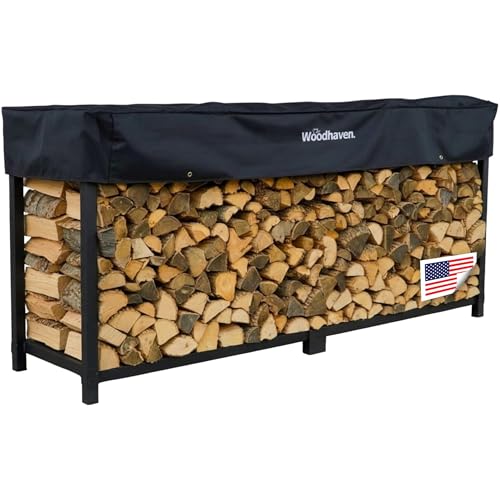
Build a firewood rack by creating two vertical supports a set distance apart and stacking the wood between them, lifted off the ground. The quickest version uses concrete blocks and 2×4s; the sturdiest uses a steel bracket kit or a built frame of pressure-treated lumber.Three common DIY approaches, from fastest to sturdiest, are listed below.
- Cinder-block-and-2×4 rack — stand a 2×4 upright in the end slot of a concrete block at each end, a few feet apart, and stack between them. No tools beyond a saw.
- Bracket-kit rack — bolt steel end brackets to your own 2×4 rails and 4×4 uprights, cutting the rails to any length you want.
- Built lumber frame — screw a base of pressure-treated 2×4s with 4×4 legs and end braces for a permanent, freestanding rack.
What materials do you need?
Gather pressure-treated lumber, exterior screws, and a level for most builds. A basic block rack needs two concrete blocks and two to four 2×4s; a framed rack needs pressure-treated 2×4s, 4×4 posts, and weatherproof deck screws so nothing rots or rusts outdoors.Keep the base off the dirt on pavers or gravel, and don’t build a freestanding stack taller than about 4 feet — tall piles lean and can fall. If you would rather buy a ready-made frame, the best firewood racks compares steel racks and bracket kits. For the block version, choose solid or heavy concrete blocks rather than lightweight ones so the uprights don’t tip, and pick 2×4 uprights long enough to rise most of the stack’s height. For a framed rack, 4×4 legs and a doubled-up 2×4 base carry heavy loads far better than single boards.
How do you build a simple block-and-timber rack?
Build the fastest sturdy rack from two concrete blocks and a few 2×4s in under an hour. The blocks hold the uprights, the uprights contain the stack, and pavers under the blocks keep the whole thing level and draining. It is the classic beginner build for good reason — cheap, quick, and hard to get wrong.Work through it in order:
- Set a concrete block at each end of a level, draining spot, a rack-length apart, on pavers or gravel.
- Stand a 2×4 upright in an end slot of each block so the boards rise vertically to contain the stack.
- Lay a base of two 2×4s flat between the blocks to lift the bottom row off the ground.
- Stack the splits between the uprights, crisscrossing the end columns to lock the rows.
- Check the uprights stay vertical as you load, and stop the stack below about 4 feet.
What mistakes should you avoid when building a rack?
The common DIY-rack mistakes are building on bare soil, using untreated wood, making it too tall, and skipping the end bracing. Each one shortens the rack’s life or makes it unstable, and all are easy to design out from the start.Watch for the errors below.
- Untreated lumber in ground contact rots within a season or two — use pressure-treated stock and keep it off the dirt.
- A too-tall freestanding stack leans and can topple — cap it near 4 feet.
- No cross-bracing at the ends lets uprights splay under load — brace them or crisscross the end columns.
- Skipping a drained base rots the bottom row and lets legs sink — set the frame on pavers or gravel.
How do you make a DIY firewood rack sturdier?
Make a rack sturdier by widening the base, bracing the ends, and keeping the stack short. Most homemade racks fail in one of three ways — the uprights splay, the base sinks, or a too-tall pile leans — and each has a simple fix built in at the design stage.Build in these reinforcements:
- Angle or brace the end uprights so a full load can’t push them outward.
- Double the base rails or add a centre support so a long span doesn’t sag.
- Set the whole frame on pavers or a gravel bed so no leg sinks after rain.
- Cap the stack near 4 feet and keep the load within the footprint so it can’t topple.
A rack built this way holds a heavy row of hardwood for years; treat the dimensions as general guidance and scale the lumber up for longer or taller builds.
How long should a DIY firewood rack be?
Size the rack to your burn: an 8-foot length holds roughly a half cord, which suits most homes. Build longer if you heat with a wood stove, and set the depth to your split length, usually about 16 inches. For sizing and placement details, see the firewood rack guide.Wear gloves and eye protection when cutting lumber, and treat these figures as general guidance — adapt the design to your climate and load.