

What size firewood rack do I need?
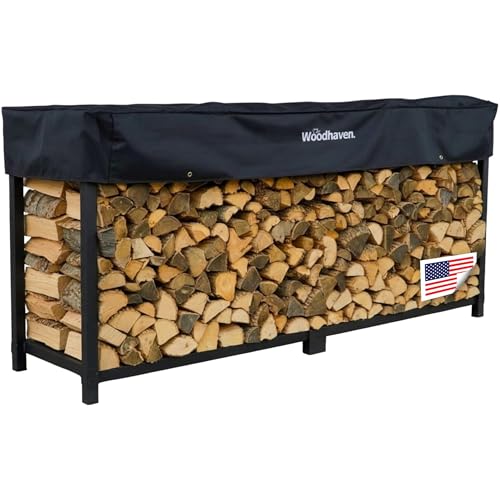
Size a firewood rack to your yearly burn so you refill it rarely. As a rough guide, a 4-foot rack holds a week or two of fireplace wood, an 8-foot rack about a half cord, and a 12-foot rack close to a full cord. Wood-stove households usually want several 8-foot racks.Capacity comes down to a few numbers, matched to typical needs below.
| Rack length | Roughly holds | Best for |
|---|---|---|
| 4 ft | Days to weeks of wood | Occasional fireplace use |
| 8 ft | About a half cord | Regular fireplace or small stove |
| 12 ft | Close to a full cord | Wood-stove heating |
What is a cord, face cord, and rick?
A full cord is a stacked pile roughly 4 ft × 4 ft × 8 ft, about 128 cubic feet; a face cord or rick is a single row 4 ft high and 8 ft long, only as deep as the splits are long. The terms cause most of the confusion when people buy wood or size a rack, so it helps to pin them down.The measurements worth knowing are set out below.
- Full cord — about 128 cubic feet stacked; the standard unit wood is sold by.
- Face cord (rick) — one 4 ft × 8 ft row, commonly 16 inches deep, so roughly a third of a full cord.
- Rack length — the spec that actually sets capacity, since most racks share the same 4-foot height and 16-inch depth.
Because a face cord’s depth depends on split length, always confirm the depth when buying wood by the rick, so you know what you are actually getting. It is worth measuring a delivery when it arrives — a stack 4 feet high and 8 feet long tells you a face cord at a glance, and comparing that to the space it fills helps you judge whether you were sold a full cord or a rick.
How much firewood does a household burn in a winter?
A household’s winter burn ranges from under a face cord for the occasional fireplace to several full cords for a wood stove used as primary heat. The exact figure depends on climate, how well the home is insulated, the appliance’s efficiency, and how many hours a day the fire runs, so treat any number as a starting estimate to size your rack against.As a rough planning guide:
- Occasional fireplace — often under a face cord over a mild winter, so a single 8-foot rack covers it with room to spare.
- Regular fireplace or a stove used part-time — commonly one to three cords, suiting two or more 8-foot racks.
- Wood stove as main heat in a cold climate — several cords a season, which means a row of racks and seasoning a full year ahead.
Because these ranges are wide, track how much you actually go through in your first winter, then size next year’s storage to match rather than guessing again.
How do you match rack size to how you heat?
Match rack length to your heat source, since a weekend fire and a primary wood stove burn wildly different amounts. A worked look at three common households shows the pattern.- Occasional fireplace — a few fires a month in winter burns maybe a face cord a season, so one 8-foot rack, or even a 4-foot rack, is ample.
- Regular fireplace or small stove — steady winter use runs through a cord or two, suiting one or two 8-foot racks you can rotate.
- Wood stove as main heat — heating a house can take several cords, so plan for multiple 8- or 12-foot racks and season a year ahead.
Buying green wood to season yourself pushes you toward more total rack length, because you need this year’s stack drying while you burn last year’s. Whichever household you are, seasoning your own wood roughly doubles the storage you need, since a drying stack and a burning stack have to coexist.
Should you size up or down?
Size up when in doubt. An under-filled rack works fine, but an overfilled one bows in the middle and leans, and you don’t want to run short mid-winter. Depth is set by your split length — usually about 16 inches — and height is capped near 4 feet for stability, so length is the number you actually choose.Buy or build a little longer than a single season needs so there is room for the next delivery. For how sizing fits with placement and covers, see the firewood rack guide, or compare ready-made options in the best firewood racks. Treat cord estimates as general guidance, since stacking and split size change how much fits. There is also a stacking factor: loosely thrown wood takes far more space than neatly stacked splits, so a rack fills faster than the raw cord figure suggests if you stack carefully. Length is also the cheapest capacity to add later — a bracket kit or a second short rack extends storage without replacing what you already have.