



What tools make firewood work easier?
Beyond a rack, the firewood tools worth owning are a moisture meter, a cant hook or log tongs, a carrier, and a kindling splitter. Each removes a specific pain point — guessing whether wood is dry, wrestling heavy logs, hauling armloads, and splitting kindling by hand.None of these are essential just to burn wood, but together they make the whole cycle faster and safer. This guide covers what each tool does and when it earns its place, so you can buy in the right order rather than all at once. For the storage side of the job, see the firewood rack picks.
How does a firewood moisture meter work?
A firewood moisture meter reads how much water is left in a split by measuring electrical resistance between two pins pushed into the wood. Dry, ready-to-burn firewood generally reads around 20% or less, while freshly cut wood can read 40% or more.Using one is quick, and the steps are listed below.
- Split a piece and test a fresh inside face, not the weathered outside.
- Push the pins into the wood along the grain.
- Read the percentage and compare it to the roughly 20% target.
Treat the 20% figure as general guidance — burning wetter wood wastes heat and coats your chimney with creosote, a fire hazard. Meters are inexpensive and take the guesswork out of seasoning, which the firewood rack guide covers alongside placement and airflow.
How do you get an accurate moisture reading?
Test a freshly split inside face at room temperature for the truest reading, because the weathered outside of a split always reads drier than its damp core. A meter checked only on the surface can pass wood that is still wet in the middle, so the technique matters as much as the tool.To read a stack honestly, work through these points:
- Split a representative piece open and press the pins into the just-exposed face, across the grain.
- Test several pieces from different parts of the stack, not one convenient split.
- Let cold wood warm toward room temperature first, since very cold wood can read low.
- Take the highest of your readings as the real state of the stack, because the wettest piece sets the risk.
Cheap meters drift over time, so if readings look implausible, check the battery and test a piece you know is bone-dry as a rough calibration. The goal is confidence that the whole stack is near 20%, not a single lucky number.
When do you need a cant hook or log tongs?
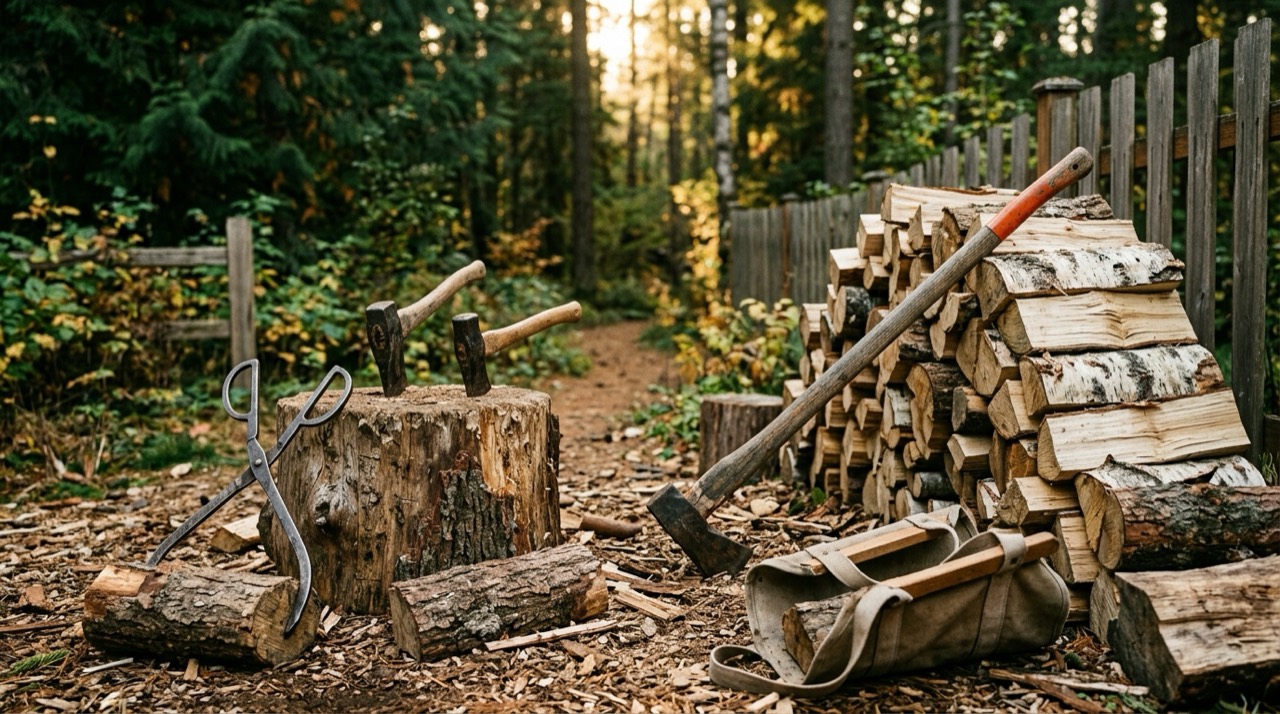
Reach for a cant hook or log tongs when logs are too heavy or awkward to move by hand. A cant hook grips and rolls logs for bucking, while log tongs let two people carry a heavy round — or let you lift splits without bending your back.These tools shine before the wood is split. A cant hook, or a peavey with its pointed tip, rolls a log off the ground so your chainsaw bar clears the dirt while bucking on a sawhorse or log stand. Log tongs and lifting hooks then move heavy rounds to the splitting axe or maul without repeated bending. For anyone processing full logs, they save both time and backs.
What is the best way to carry firewood?
A dedicated firewood carrier — a canvas tote or a steel-frame log cart — moves far more wood per trip than your arms. A tote sling lets you carry an armload without splinters or dropped pieces, and a wheeled cart handles heavy loads across the yard.Carriers are the tool people underrate. A simple waxed-canvas log tote keeps bark and bugs off your clothes and sets the whole load down by the hearth in one motion. For longer hauls from an outdoor rack, a two-wheel cart or garden cart moves a wheelbarrow’s worth at once. Keeping a small indoor rack or tote by the stove also means fewer cold trips outside. Choose the carrier to fit the trip: a shoulder tote for short indoor runs, a two-wheel hand cart for a rack across the yard, and a garden cart or wheelbarrow for a full delivery. Whatever you pick, keep the load balanced and within what your back can manage, and set it down close to the hearth so you handle each split only once.
Do you need a kindling splitter?
A kindling splitter is worth it if you light a lot of fires and want to make kindling safely. These cast-iron or steel devices hold the blade fixed while you strike the wood with a mallet, keeping your hands clear of the edge — far safer than swinging a hatchet at small sticks.Kindling splitters trade a little speed for safety and consistency. You place a small split in the ring, tap it through the fixed blade, and get uniform kindling with no loose axe swing. They aren’t essential — a hatchet and a stable block also work — but they remove the most common way people cut themselves making kindling. Keep fingers clear and use a wooden or rubber mallet as the maker directs.
When is a powered log splitter worth it?
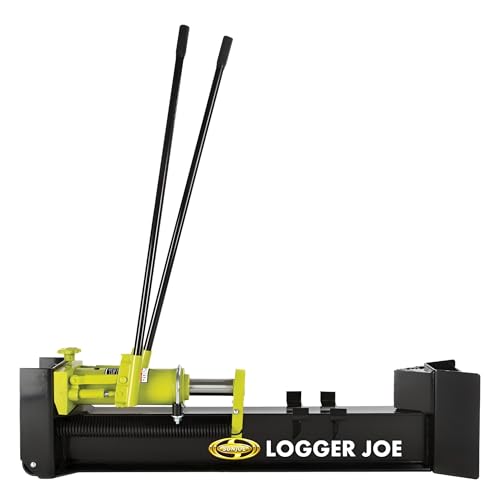
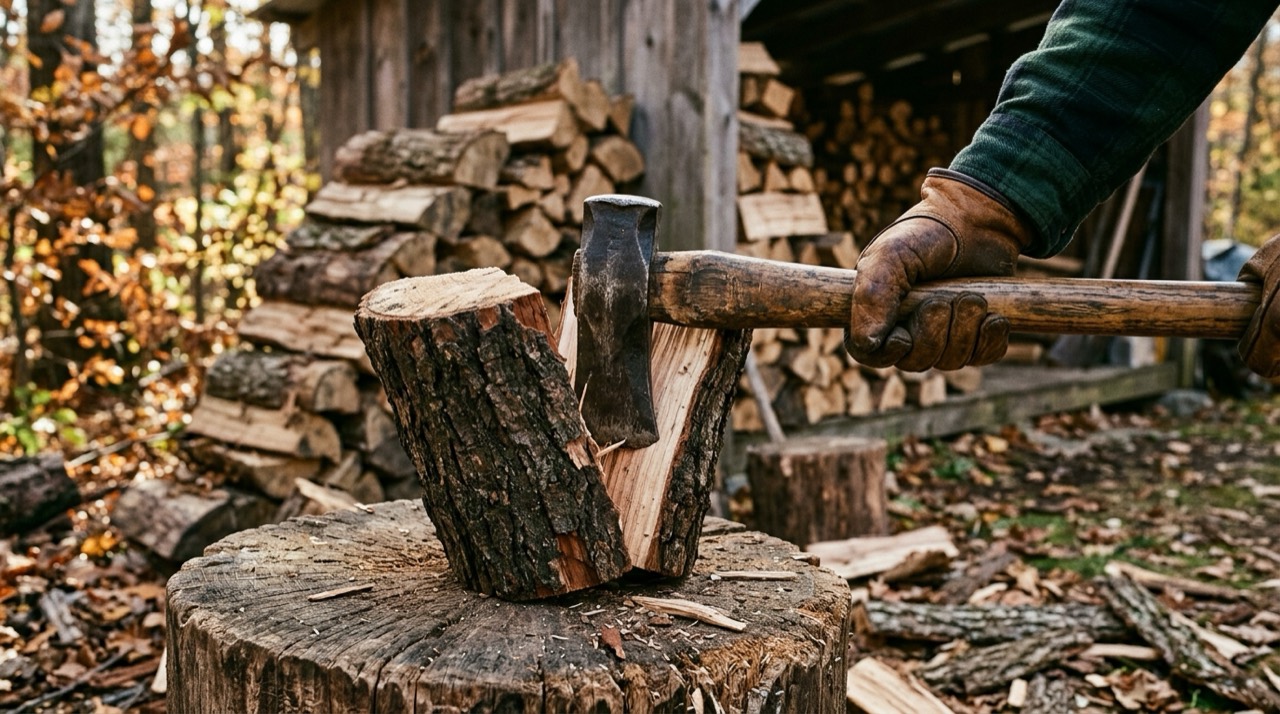
A powered log splitter earns its place once you process more than a cord or two a year, or when knotty, twisted rounds resist a maul. Hand splitting with a splitting axe or maul is cheap, quiet, and good exercise for smaller volumes, but it gets slow and hard on the body at scale.The deciding factors are volume, wood type, and your own limits, set out below.
- Under a cord a year of straight-grained wood — a maul and a stable block are usually enough.
- Several cords, or dense knotty rounds — an electric log splitter saves shoulders and time for suburban use.
- Large logs or off-grid work — a gas or hydraulic splitter handles the biggest, greenest rounds.
A splitter is a bigger purchase than the small tools here, so it belongs at the end of the buying order, once a meter, carrier, and hand tools are already in the kit.
What safety gear do firewood tasks need?
Firewood work calls for sturdy gloves, eye protection, and closed footwear at a minimum, with hearing protection added whenever a chainsaw or powered splitter runs. Handling rough splits, swinging steel, and feeding logs into machines all carry injury risk that basic gear largely prevents.Match the protection to the task, as set out below.
- Stacking and carrying — work gloves against splinters and pinches, plus closed shoes.
- Splitting by hand — gloves, eye protection, and a clear swing zone with no bystanders.
- Chainsaw bucking — chainsaw chaps and PPE and hearing and eye protection.
- Powered splitting — snug sleeves, no loose gloves near the wedge, and one operator at a time.
Know your limits, too: felling a standing tree, dealing with a leaning or hung-up trunk, or bucking large logs on a slope is work for a trained professional with the right gear, not a weekend job.
How do you maintain firewood tools?
Keep firewood tools working by drying them after use, storing them under cover, and checking the parts that wear. Steel hooks and tongs rust if left wet, canvas carriers rot if stored damp, and a moisture meter is useless with a flat or corroded battery — a few minutes of care keeps the whole kit ready.A simple maintenance routine covers most of it:
- Wipe steel tools dry and give hooks and tongs a light oil before storing them indoors.
- Touch up any rust or dull points on a cant hook so it still bites into logs.
- Shake out and dry canvas totes, and store them out of the weather.
- Remove the meter’s battery for long storage and keep the pins clean and straight.
Treat these as general guidance and adjust to how hard you use the tools — a kit used every winter needs more attention than one that comes out a few times a year.
Which firewood tools are worth buying first?
Buy a moisture meter first, then a carrier, then the heavy-log tools. The meter is cheap and prevents the biggest firewood mistake — burning wet wood — while a carrier saves your back and clothes on every load. Cant hooks, tongs, and kindling splitters follow based on how much wood you process.Match the tools to your workload, as shown below.
- Fireplace users buying seasoned wood mainly need a meter and a carrier.
- Wood-stove burners seasoning their own splits add a cant hook and log tongs.
- High-volume processors round out the kit with a log splitter and a kindling splitter.
Start small and add tools as the yearly firewood job grows.