

What is the difference between a machete and a kukri?
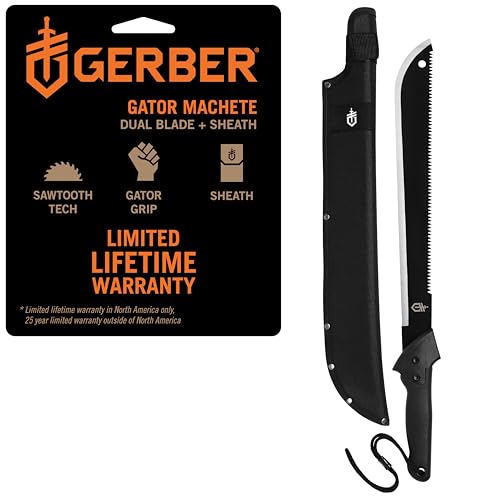
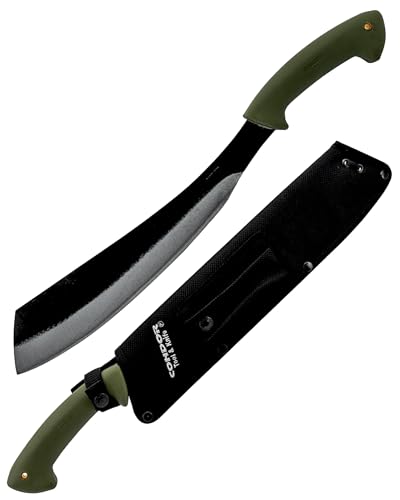
A kukri is a type of machete with a distinctive forward-angled, recurved blade that drives chopping force toward the tip, while a standard machete usually has a straight or gently curved blade suited to slicing and sweeping. Both clear vegetation, but they favor different cutting actions.
The key differences come down to blade shape and how each cuts:
| Attribute | Straight machete | Kukri machete |
|---|---|---|
| Blade shape | Straight or gently bellied | Forward-angled recurve |
| Best action | Slicing and sweeping | Chopping |
| Ideal growth | Grass, vines, light brush | Woody stems and saplings |
| Sharpening | Fast on a flat edge | Slower on the recurve |
Why does a kukri chop harder than a straight machete?
A kukri chops harder because its forward-angled blade shifts the balance point and the impact toward the tip, so each swing lands with more concentrated force — much like a small axe. The downward bend in the edge also drives the cut into the stem rather than glancing along it.
A straight latin machete spreads its weight evenly along the blade, which is ideal for fast, sweeping slices through grass and vines but delivers less punch against a woody stem. The kukri's geometry concentrates mass and angle where the blade meets the wood, letting a shorter kukri out-chop a longer straight blade on saplings and thick stems. The trade-off is that all that tip-weight and curve make the kukri slower and clumsier on light grass, where a straight blade sweeps more ground with less effort.
Which should you choose for your growth?
Choose a kukri if your ground is dominated by woody stems and saplings, and a straight machete if you mostly cut grass, vines, and light mixed brush. The right pick follows the vegetation you clear most, not which blade looks more capable.
Use this guidance to match blade to growth:
- Mostly grass, vines, and light brush — a straight latin machete sweeps more ground per stroke and is easier to sharpen and control.
- Mostly woody saplings and thick stems — a kukri chops with far less effort and fewer strokes.
- A genuine mix of both — a straight 18-inch blade is the more versatile default, with a kukri or hatchet added for the woody work.
What about sharpening and other machete types?
A kukri is slower to sharpen than a straight machete because its recurved edge needs a rounded file or the corner of a stone to reach the inner curve, while a straight edge takes a fast, even file stroke. Neither replaces a saw or splitting axe for real firewood or felling work.
The kukri is only one of several weight-forward patterns — a bolo bulges toward the tip, and a parang uses a long forward curve — all of which trade slicing reach for chopping power. If your ground is mostly woody, any of these earns its place; for mixed clearing, a straight blade remains the versatile default.
How does a kukri compare with a bolo and a parang?
A kukri, a bolo, and a parang are all weight-forward machetes that chop better than a straight blade, but they get there by different means. A kukri uses a sharp forward angle, a bolo uses a bulge near the tip, and a parang uses a long, smooth forward curve.
The three weight-forward machete patterns and how each cuts are compared below.
| Pattern | Blade shape | Chopping style | Sharpening |
|---|---|---|---|
| Kukri | Sharp forward angle, recurve | Axe-like, concentrated at the bend | Slower on the recurve |
| Bolo | Straightish with a tip bulge | Weight-forward chop for cane | Easy, mostly straight edge |
| Parang | Long, smooth forward curve | Powers through woody green wood | Moderate, along a curve |
All three out-chop a straight latin blade on woody stems, and all three are slower than a straight blade on light grass. The bolo is the easiest of the three to sharpen and a common budget choice for cane and light brush, the kukri hits hardest for its length, and the parang resists binding in green, sappy wood.
Which is easier for a beginner to use safely?
A straight latin machete is generally the easier and safer choice for a beginner, because its balanced weight and predictable, sweeping cut are simpler to control than a tip-heavy kukri. The kukri's concentrated chopping force is an advantage in experienced hands but less forgiving of a mistimed swing.
A new user clearing mixed growth will get cleaner results and fewer near-misses with a straight 18-inch blade, adding a kukri or hatchet later for the woody work. Whichever style you start with, the same rules apply: cut-resistant work gloves, eye protection, a clear swing zone, and a stroke that always travels away from your legs. Neither blade replaces a saw or splitting axe for real firewood or felling work. Compare both styles on the machete buying guide.

