

What is a machete?
A machete is a long, single-edged blade, usually between 10 and 28 inches, built to clear brush, vines, grass, and saplings with a swinging chop rather than a sawing cut. It is a deliberately simple tool — one broad blade and one handle — designed for fast, low-cost clearing across mixed ground.
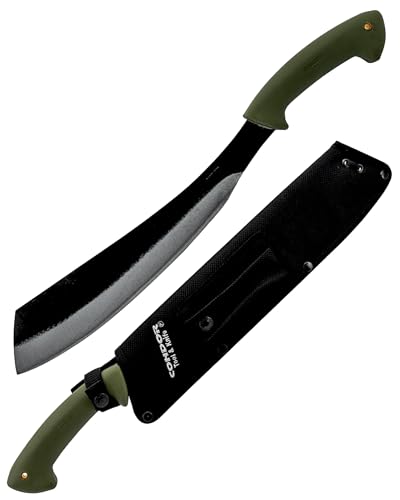
Machetes come in several blade profiles suited to different vegetation. A straight latin blade slices grass and light brush, a bolo carries weight toward the tip for chopping cane and saplings, a kukri uses a forward-angled recurve for hard chopping, and a parang or panga bites into dense, woody growth. Most are made from carbon steel, which takes a durable edge and re-sharpens easily but needs drying and oiling to prevent rust.
What are the parts of a machete?
A machete has four main parts: the blade, the edge, the tang, and the handle. Each does a distinct job, and understanding them makes it easier to choose a durable blade and to maintain one safely over years of clearing work.
The parts of a machete and what each does are listed below.
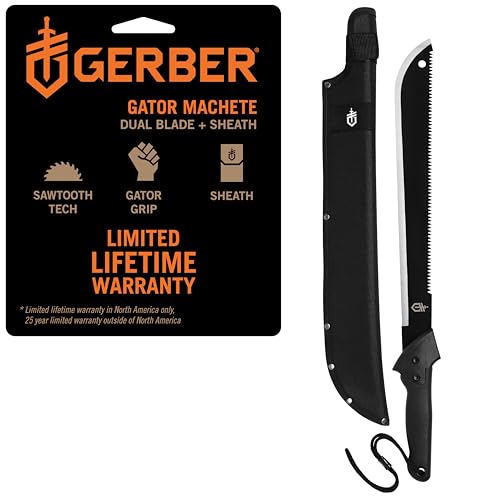
- Blade — the broad, flat length of steel that carries the cutting edge; its thickness and weight set whether the tool slices or chops.
- Edge — the single sharpened bevel, ground coarse and obtuse so it survives impact against woody stems and hidden stones.
- Spine — the thick, unsharpened back, sometimes fitted with coarse saw teeth for the occasional thicker limb.
- Tang — the portion of the blade steel that extends into the handle; a full tang runs the whole length and resists loosening under hard use.
- Handle — the grip, usually textured rubber, molded polymer, or riveted wood, that keeps the tool secure in wet or gloved hands.
What is a machete used for?
A machete is used to clear low, mixed, mostly soft vegetation — brush, vines, grass, cane, and thin saplings — and to handle light camp and garden chores. It is a clearing and trimming tool, not a felling or splitting tool, so it stops where the wood turns thick.
Beyond clearing overgrowth, a machete limbs thin branches, cuts back brambles and vines, chops kindling, opens a trail, and harvests garden crops like sugar cane and corn stalks. What it does not do well is fell trees, split firewood, or cut through wrist-thick wood; those jobs belong to a saw, an splitting axe, or a brush cutter. Trying to force a machete past its role tires you out and raises the risk of a stuck or glancing blade.
How is a machete different from a knife or an axe?
A machete sits between a knife and an axe: longer and heavier than a knife for sweeping through vegetation, but thinner and softer than an axe so it flexes instead of chipping. That middle ground is what makes it a clearing specialist rather than a cutting or splitting tool.
A knife is short and hard for fine, controlled cuts, while an axe is short, heavy, and thick for concentrated chopping and splitting force. A machete's long, thin, deliberately soft blade trades both of those for reach and speed across soft growth. Because that exposed blade causes serious cuts, safe use means cut-resistant work gloves, eye protection, a clear swing zone, and a controlled stroke that keeps the edge away from your legs.
Where did the machete come from and who uses one?
The machete began as an agricultural tool for cutting sugar cane and clearing land, and it remains one of the most widely used farming and land-clearing blades in the world. Today its users range from cane and crop farmers to trail crews, gardeners, and rural homeowners.
On farms it harvests cane, corn, and other tall crops and keeps field margins clear; on trails and rural blocks it opens paths, knocks back seasonal regrowth, and cuts firebreak lines through light brush. For a homeowner, a machete earns its place on any block with vines, blackberry, or overgrown corners that a mower cannot reach and that do not justify a powered brush cutter. Its appeal is unchanged across all these users: a cheap, simple, low-maintenance blade that clears a lot of soft growth with no fuel, cords, or batteries.
To see how machetes fit alongside loppers, pruning saws, and other clearing blades, start at the hand and cutting tools hub, or compare specific models on our best machetes guide.

