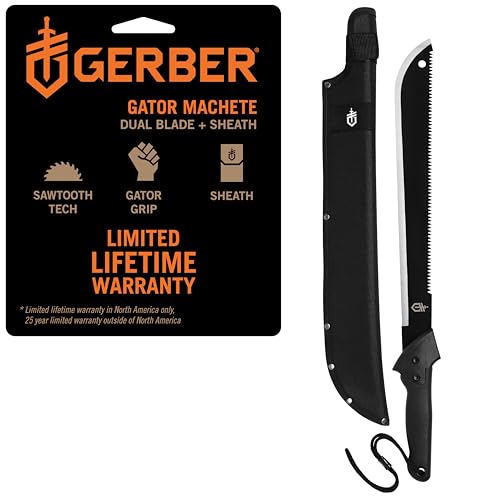

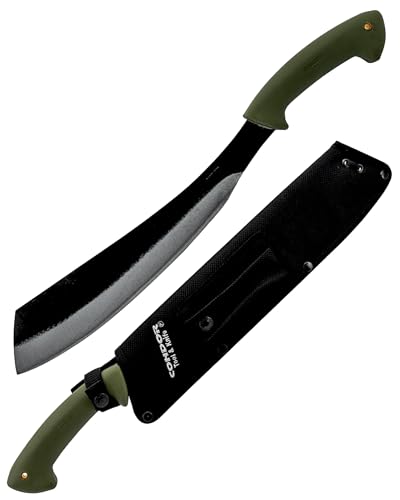
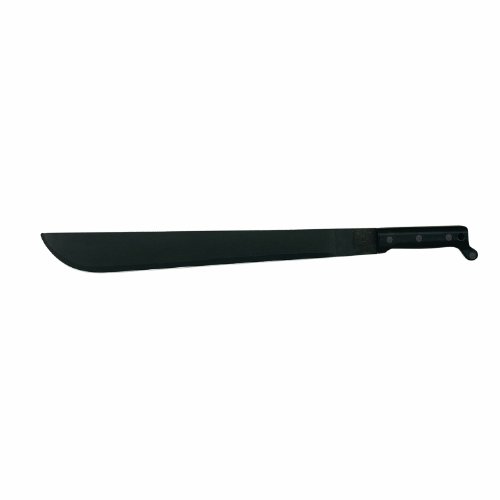


How do you clear brush with a machete without wearing yourself out?
Clear brush efficiently by letting blade speed and a relaxed wrist do the cutting instead of muscling every stroke. Work in short sessions, cut vegetation low and at an angle, and keep the blade sharp so each swing bites cleanly rather than bouncing off tough stems.
Fatigue and injuries both climb when a machete is dull or the swing is stiff and over-powered. A sharp edge and a loose, snapping stroke cut more with less effort, keep the blade under control, and reduce the wild follow-through that causes accidents. Pace yourself, take breaks, and stop when your grip or aim starts to fade. Working methodically across an area in strips, rather than hacking at whatever is closest, also saves energy and leaves cleaner ground behind you. Keep a file within reach and touch up the edge as soon as the blade starts to bounce off stems instead of biting.
What should you wear and set up before you start?
Set up for safety before the first swing. Wear cut-resistant work gloves, eye protection, long sleeves, and sturdy boots, then clear the area of bystanders, pets, and trip hazards so nothing enters your swing arc.
The gear and checks to complete before you begin are listed below.
- Cut-resistant gloves to protect the hand guiding brush and the hand on the grip.
- Eye protection against flicked debris, thorns, and snapped stems.
- Boots and long trousers to guard your feet and legs from a low or over-travelling blade.
- A clear swing zone with people and animals kept more than a full blade-and-arm length away.
- A planned escape for the blade, so a missed stroke ends in the ground or open air, never toward your body.
How do you plan and work through a clearing project?
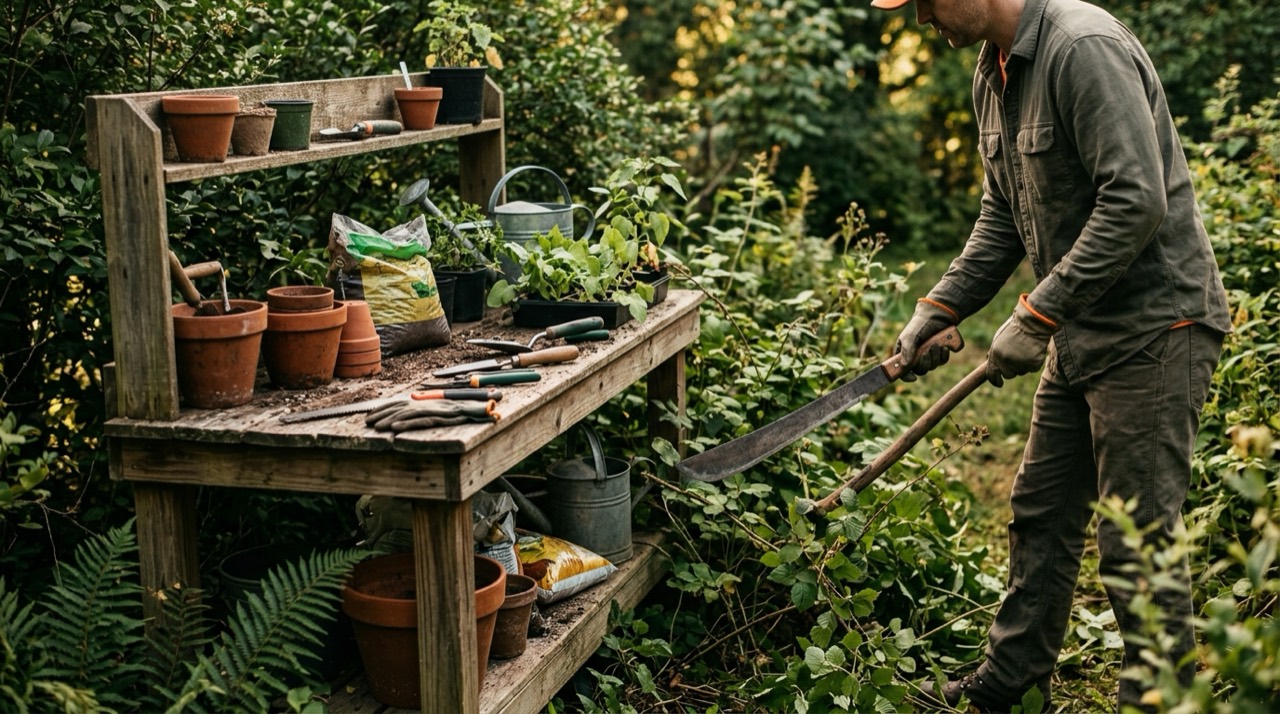
Work a clearing project in planned strips rather than attacking the thickest patch first. Start at one edge, cut a manageable lane you can stand in, then advance into the growth so you always swing into cut ground and pull cleared material back behind you.
Following a system turns a chaotic hack-fest into steady, safe progress. Use these steps to work through an overgrown area:
- Walk the area first and flag hidden hazards — rocks, stumps, wire, irrigation lines, and holes — before any blade comes out.
- Cut a clear standing lane along one edge so you have firm footing and room to swing.
- Work in strips roughly a blade-and-arm wide, advancing into the growth and cutting away from your body.
- Drag cut material into piles behind you as you go, so it never tangles your feet or hides the ground.
- Take the tall growth down in two passes — a high cut to drop the bulk, then a low cut to leave a short, mow-able stub.
Staging the work this way keeps your footing clear, stops cut brush from snagging the next stroke, and lets you stop and rest at a tidy boundary rather than in the middle of a tangle.
What is the correct machete swing?
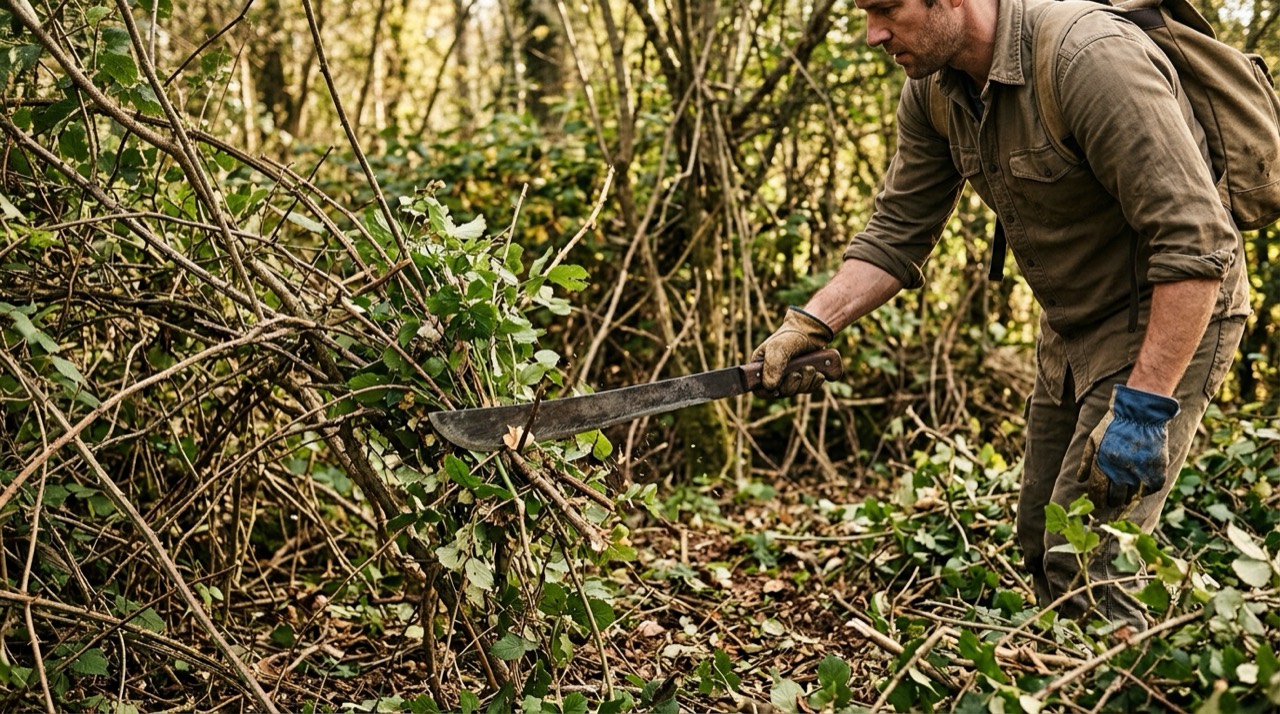
The correct swing is an angled, wrist-led stroke that meets the vegetation at roughly 45 degrees. A diagonal cut slices through stems instead of stalling against them, and it keeps the blade moving away from your legs on the follow-through.
Use these steps for a controlled, repeatable swing:
- Stand with your feet shoulder-width apart and your weight balanced.
- Grip the handle firmly but not rigidly, keeping your wrist relaxed.
- Swing from the elbow and shoulder, adding a wrist snap at the moment of impact.
- Strike the stem at a downward diagonal so the edge slices rather than chops flat.
- Let the blade travel through into open ground, never toward your shin or off hand.
How do you cut different types of growth?
Different growth needs different technique. Grass and vines cut with fast, shallow diagonal sweeps; brambles and cane need firmer angled strokes near the base; woody saplings take a weight-forward chop, and anything thicker than a wrist is better cut with a saw or axe.
The main growth types and how to tackle each are listed below.
- Grass and reeds — sweep the blade in low, flat arcs and let its speed shear the stems.
- Vines and brambles — cut near the base at an angle and pull cut lengths clear as you go.
- Cane and thin saplings — use firm, downward diagonal strokes, letting a bolo or kukri belly add force.
- Woody stems near wrist thickness — switch to a chopping tool such as splitting axes and mauls or a saw rather than forcing the machete.
How do you cut brambles, blackberry, and thorny vines safely?
Cut brambles and blackberry from the base upward, taking the canes low and dragging them clear before they can whip back or snag you. Their thorns and springy stems make them the most hazardous common growth to clear, so gloves, eye protection, and a taut off-hand hold matter most here.
Rather than swinging into a solid thorny mass, work the edge of the patch and peel it back stem by stem. Cut each cane low, near the crown, then use a gloved hand or a hooked stick to pull the severed length away and stack it, keeping your pulling hand well behind the blade's line. Green, sap-heavy vines cut more easily than they look, but they also dull and gum an edge quickly, so wipe the blade during longer sessions and touch up the file when it stops biting. For a stubborn root crown, cut the top growth with the machete and dig or grub out the root separately, rather than hacking at ground level where the blade meets hidden stones.
How do you cut saplings and woody stems?
Cut saplings and woody stems with a weight-forward chop at a steep downward angle, aiming to sever the stem in two or three overlapping strokes rather than one flat hack. A bolo, kukri, or parang belly adds the mass a straight blade lacks, but any stem past wrist thickness should move to a saw.
Notch a thicker sapling with angled cuts from both sides, the way you would nick a small log, so the blade shears through fibers instead of getting pinched and stuck. Keep your body and legs out of the line of travel, because a blade that glances off a hard, springy stem can carry a long way. If the machete bounces, binds, or refuses to bite after a few strokes, that is the signal the stem is too woody for a hand blade — reach for a pruning saw or a chopping axe instead of forcing it.
What common mistakes make machete clearing dangerous or slow?
Most machete accidents and wasted effort trace back to a handful of avoidable mistakes: a dull blade, an over-powered swing, cutting toward the body, a wet or loose grip, and skipping protective gear. Fix these and clearing becomes both faster and much safer.
The clearing mistakes worth catching before they cause an injury are listed below.
- Swinging a dull blade — a blunt edge bounces off stems and forces harder, less controlled swings, so touch up the edge the moment it stops biting.
- Over-powering the stroke — muscling every swing tires you fast and produces a wild follow-through; let blade speed and a wrist snap do the cutting.
- Cutting toward your body — a blade aimed across your legs or off hand is one slip from a serious wound, so always plan the stroke to travel into open ground.
- A wet or loose grip — sweat, rain, or sap on the handle costs control; dry the grip, wear gloves, and re-secure any handle that moves on the tang.
- Clearing without gear — bare arms, soft shoes, and no eye protection turn a minor miss into an injury, so treat work gloves, boots, and eye protection as non-negotiable.
- Working when tired — fatigue wrecks aim and grip, so stop and rest before your accuracy fades rather than after.
When should you stop and reach for a different tool?
Stop using a machete once growth turns woody, overhead, or dense enough to resist a clean cut. Large or leaning trees, limbs above head height, and heavy stands of woody brush belong to a chainsaw, a brush cutter, or a trained professional, not a hand blade.
A machete is a clearing and trimming tool, and pushing it past that role tires you out and raises the risk of a stuck blade or a lost-control swing. When you meet trunks, thick roots, or work near power lines, put the machete down and choose the right powered tool. Overhead limbs and any work that would put you on a ladder are especially risky with a swinging blade and are better left to a pole saw or a trained professional. For the full range of clearing blades and how they compare, start at the hand and cutting tools hub.