




Why is a chipper shredder so dangerous?
A chipper shredder is dangerous because its feed rollers and blades pull material inward faster than you can pull back, and anything caught with a branch — a glove, a sleeve, a hand — goes with it. Thrown chips and stalled-then-freed rotors add flying-object and crush risks on top.The infeed is designed to grab. That is what makes it feed branches efficiently, and also what makes it unforgiving of a loose cuff or a hand near the opening. Add spinning knives, a discharge chute that ejects chips at speed, and a heavy rotor that stores energy, and you have a machine that demands respect every second it runs. Treat it the way you would a running chainsaw: never within reach of the cutting parts, never distracted, never rushed.
What PPE does a chipper shredder require?
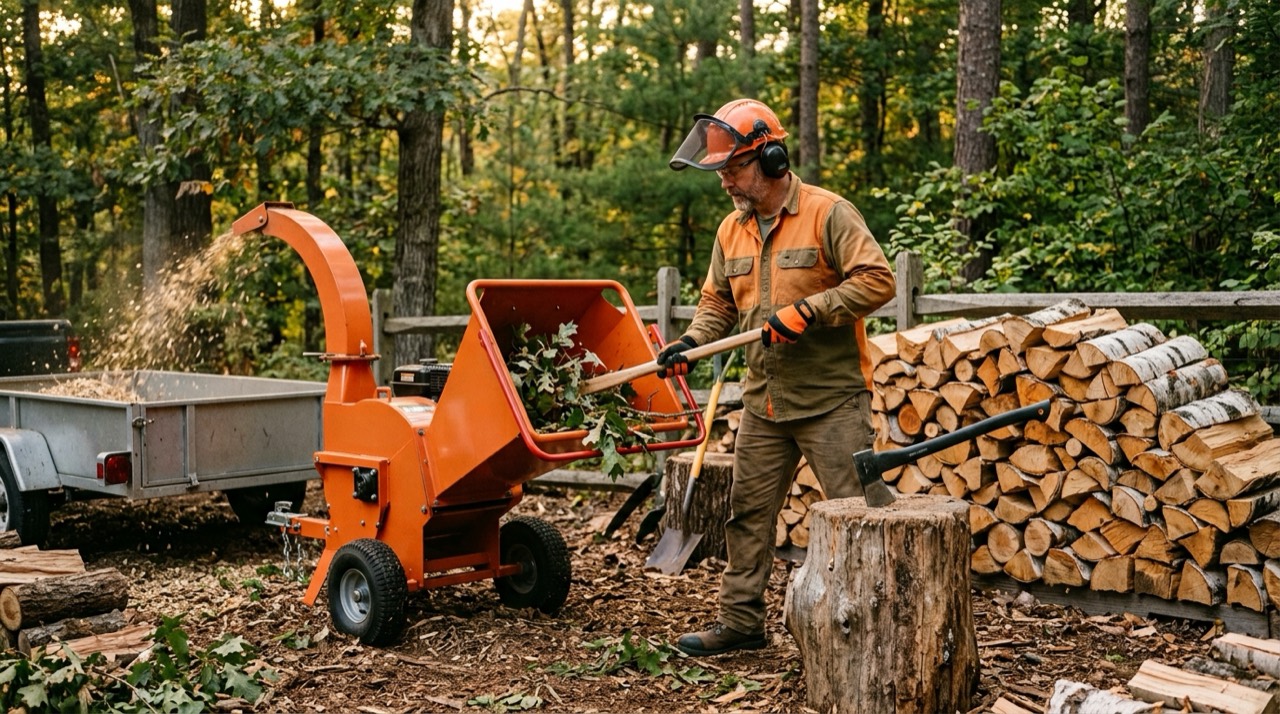
A chipper shredder requires eye protection, hearing protection, snug gloves, and close-fitting clothing at minimum, with sturdy boots and a face shield for heavier work. The goal is to leave nothing loose that the infeed can grab and to guard against thrown chips and noise.The essential gear is listed below.
- Wear wraparound safety glasses or goggles against ejected chips and grit
- Wear hearing protection because gas chippers run loud enough to damage hearing
- Wear snug work gloves with no loose cuffs for grip and cut resistance
- Wear close-fitting sleeves with no drawstrings, scarves, or dangling jewellery
- Wear sturdy boots and, for chip-back, a full face shield
Loose clothing is the single biggest avoidable hazard, because the roller cannot tell a shirt cuff from a twig. Tuck everything in and tie back long hair before you switch on.
How do you feed a chipper shredder safely?
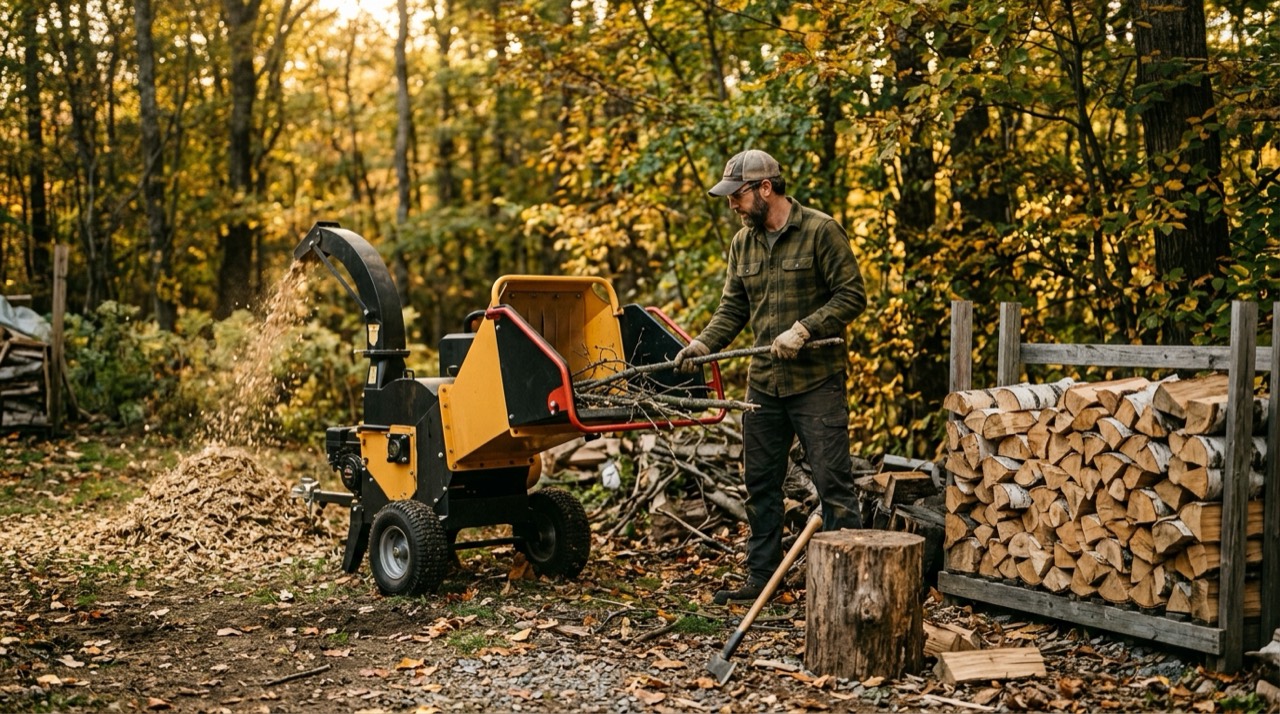
Feed a chipper shredder from the side of the chute, never with your hands over the opening, and let the machine pull the branch rather than forcing it. Keep the thick end going in first, stand clear of the discharge, and use a push stick for short pieces.Position yourself beside the infeed, not directly in line with it, so a kicked-back branch misses you. Feed one branch at a time for small machines, thick end first, and release it before your hands near the opening — let a longer branch push the last of a short one through. Keep both feet planted, keep bystanders and pets well back, and always know where the shut-off bar or switch is. If the engine note drops or the machine bogs, stop feeding and let the rotor recover speed before adding more.
How do you clear a jam without getting hurt?
Clear a jam only after the machine is fully off and the rotor has completely stopped, never while it idles. Shut it down, disconnect the spark plug boot on gas models or unplug an electric, wait for all motion to cease, then clear the blockage with a tool.Most jams happen when material is too wet, too thick, or fed too fast. The discipline that prevents injury is simple and non-negotiable: no hand enters the hopper or chute while there is any power to the machine. On gas units, pulling the spark plug boot guarantees it cannot fire while your hand is inside; on electric units, unplug rather than trusting the switch. Once clear, check the blades and screen before restarting, because a jam often signals a dull knife or a clogged screen that will jam again.
What are the core rules that prevent chipper shredder injuries?
The core rules are simple and non-negotiable: keep hands away from the infeed, feed from the side, never reach in with any power to the machine, wear full PPE, and stop the moment anything feels wrong. Follow them every time, without exception.These rules matter more than any feature on the machine, and they are listed in order of importance below.
- Never put a hand inside the hopper or chute while the machine has power — this single rule prevents the most serious injuries.
- Feed from the side of the chute, never standing in line with or over the opening.
- Let go of a branch before your hands reach the infeed, and use a longer branch or push stick to move a short one through.
- Wear eye and hearing protection, snug gloves, and close-fitting clothing with nothing loose to be grabbed.
- Keep the shut-off within reach and know exactly where it is before you start.
- Stop and shut down fully at the first sign of a jam, an odd noise, or fatigue.
Memorise these before you switch on, because the machine gives no second chance once material — or a hand — is caught.
How do you set up the work area before you start?
Set up the work area on firm, level ground with clear space around the discharge, bystanders well back, and the shut-off within reach before the rotor ever turns. A safe session is decided before you feed the first branch.Work through the setup in order, listed below.
- Choose firm, level ground and chock the wheels so the machine cannot shift or tip.
- Clear the discharge zone so no one stands where chips are thrown, and keep children and pets well outside the work area.
- Lay out your brush within easy reach on the feed side, so you never have to turn your back or stretch.
- Confirm the blades and screen are clean and tight, and that all guards are in place.
- Put on hearing and eye protection and snug work gloves, and remove anything loose.
A tidy, planned setup means you feed calmly from one spot rather than reaching, twisting, or rushing — the movements that put a hand near the infeed.
Why does side-feeding matter, and how do you do it right?
Side-feeding matters because it keeps your body out of the line of the infeed, so a branch that kicks back or is snatched inward cannot drag your hand or arm with it. Stand beside the chute, feed the thick end first, and step back as the machine takes the wood.The infeed is built to grab, and that force does not distinguish a branch from a sleeve or a hand held over it. Standing directly in front of the opening puts you exactly where a snatched branch — or your own grip on it — travels. Position yourself to the side instead, present the branch thick-end first, and release it early so the machine pulls the wood while your hands stay clear. For short offcuts, never push with your fingers; let a longer branch push the shorter one through, or use the tamper the maker supplies. Keep your feet planted and your weight back, not leaning over the hopper. Side-feeding is the difference between the machine taking only the wood and the machine taking whatever is attached to it.
What should you do if clothing or a hand is caught?
If clothing or a hand is caught, hit the shut-off or kill switch instantly and do not pull against the machine — the infeed is stronger and faster than you are. Every safe setup puts that control within reach precisely for this moment.Prevention is the real answer, because once the infeed has material there is very little time. That is why loose clothing, dangling drawstrings, and hands over the opening are forbidden, not merely discouraged. Should the worst happen, the priorities are to stop the machine at once using the shut-off bar or switch positioned within reach, then to cut power fully — pulling the spark plug boot on a gas engine or unplugging an electric — before anything else. Serious entanglement is a medical emergency: call for help immediately and do not attempt to free a trapped limb by forcing the still-powered machine. This is also why working with a second person nearby, or at least a phone on you, is part of safe operation. The machine's speed is unforgiving, so the whole discipline of PPE and side-feeding exists to make sure this moment never arrives.
Who should not operate a chipper shredder?
Children, untrained users, anyone fatigued or distracted, and anyone unwilling to wear full PPE should not operate a chipper shredder. This is not a casual garden tool, and confidence without training is exactly the risk it punishes.The machine demands steady attention and disciplined technique, so an operator who is rushed, tired, or unfamiliar with the controls is a hazard to themselves and everyone nearby. Keep children and bystanders well clear at all times — never let a child feed material or stand near the discharge. Anyone new to the machine should read the manual, learn the shut-off, and start with small, straightforward branches before attempting volume. And any task the machine is not built for — a limb beyond its rated diameter, a leaning or storm-hung tree, work near power lines — belongs to a trained arborist with the right gear, not a backyard operator. Matching the operator, and the job, to the machine is as much a part of safety as any guard or push stick.
When should you stop and call a professional?
Stop and call a trained professional for any limb beyond the machine's rated diameter, any leaning or storm-hung tree, and any work near power lines or overhead. A backyard chipper handles cut brush on the ground, not standing tree work.These guides are general information, not training. Felling, limbing standing trees, and clearing storm damage carry hazards a chipper cannot make safe, and a qualified arborist has the gear and experience the job needs. Use the chipper for what it is good at — reducing brush you have already safely cut and lowered to the ground — and route the bigger, higher, or heavier work to someone trained for it.