




How do you mix two-stroke fuel for a chainsaw?
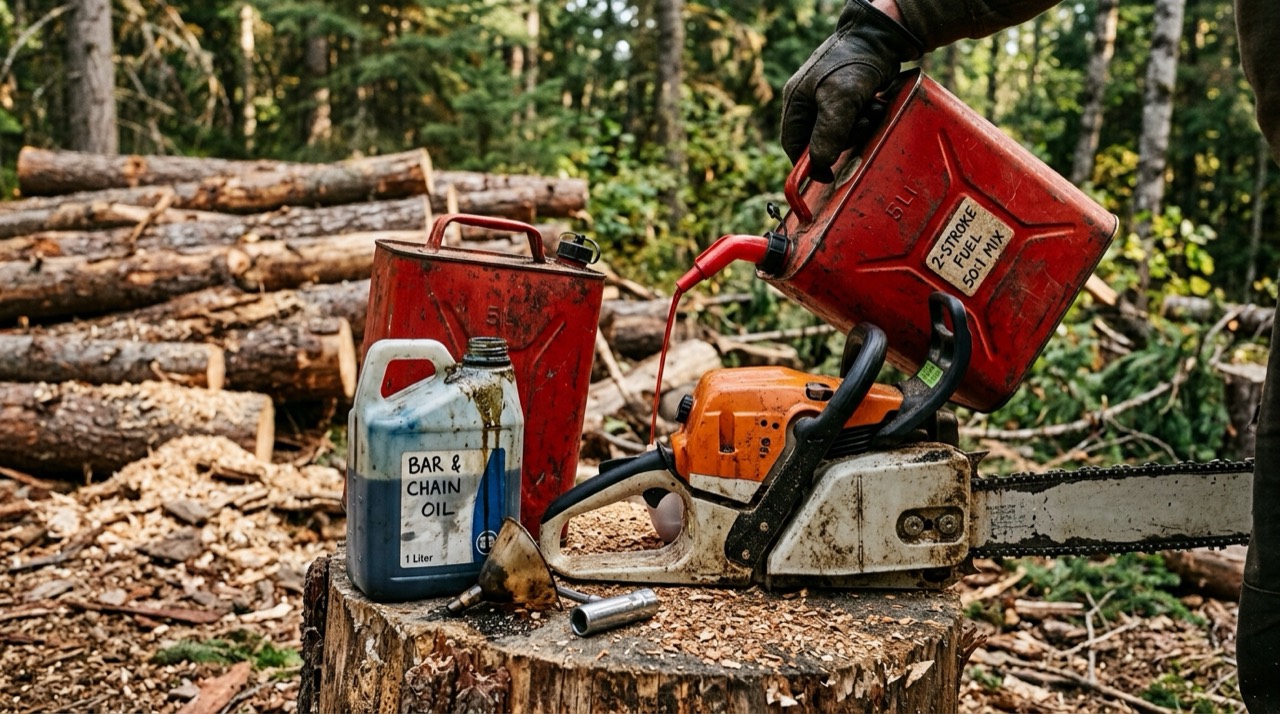
Mixing two-stroke chainsaw fuel means blending fresh petrol with a measured amount of two-stroke engine oil at the ratio your saw specifies, then shaking it in an approved fuel can before filling. Get the ratio and the fuel quality right and the engine is lubricated, starts easily, and runs clean.
Two-stroke chainsaw engines have no separate oil sump — the oil rides in the fuel and lubricates the crank and piston as it burns. That is why the mix has to be accurate: too little oil starves and seizes the engine, while too much fouls the plug and clogs the exhaust.
What is the 2-stroke fuel mix ratio chart?
The mix ratio tells you how much oil to add per unit of petrol, and it is set by your saw maker. The chart below gives the common ratios in US and metric measures; always start from the figure printed in your saw's manual.
| Mix ratio | Petrol | Oil (US) | Oil (metric) | Typical use |
|---|---|---|---|---|
| 50:1 | 1 US gal / 1 L | 2.6 fl oz | 20 ml | Most modern saws |
| 40:1 | 1 US gal / 1 L | 3.2 fl oz | 25 ml | Some older or mid saws |
| 32:1 | 1 US gal / 1 L | 4.0 fl oz | 31 ml | Older and some pro saws |
| 25:1 | 1 US gal / 1 L | 5.1 fl oz | 40 ml | Vintage and select brands |
A 50:1 mix is 50 parts petrol to 1 part oil. Modern Stihl and Husqvarna saws are specified at 50:1 with the maker's own oil; running a richer ratio than specified does not "protect" the engine — it just smokes and fouls.
Which petrol and oil should you mix?
Use fresh unleaded petrol of at least 89 octane with no more than 10% ethanol (E10), and ideally ethanol-free fuel where you can buy it. Pair it with a two-stroke oil rated JASO FD or ISO-L-EGD, the clean-burning grades for air-cooled engines. Avoid E15 or E85, which can damage two-stroke fuel systems, and avoid TCW outboard oils, which are made for water-cooled engines and leave more deposits in an air-cooled saw.
Ethanol is the main enemy of small engines: it attracts water and breaks down within about 30 days, gumming carburettors and corroding fuel lines. If a saw sits for weeks, either stabilise the fuel or switch to canned pre-mix. Buying petrol from a busy station with fresh stock, and only mixing what you will burn soon, keeps the fuel in good condition and the carburettor clean.
What equipment do you need to mix fuel?
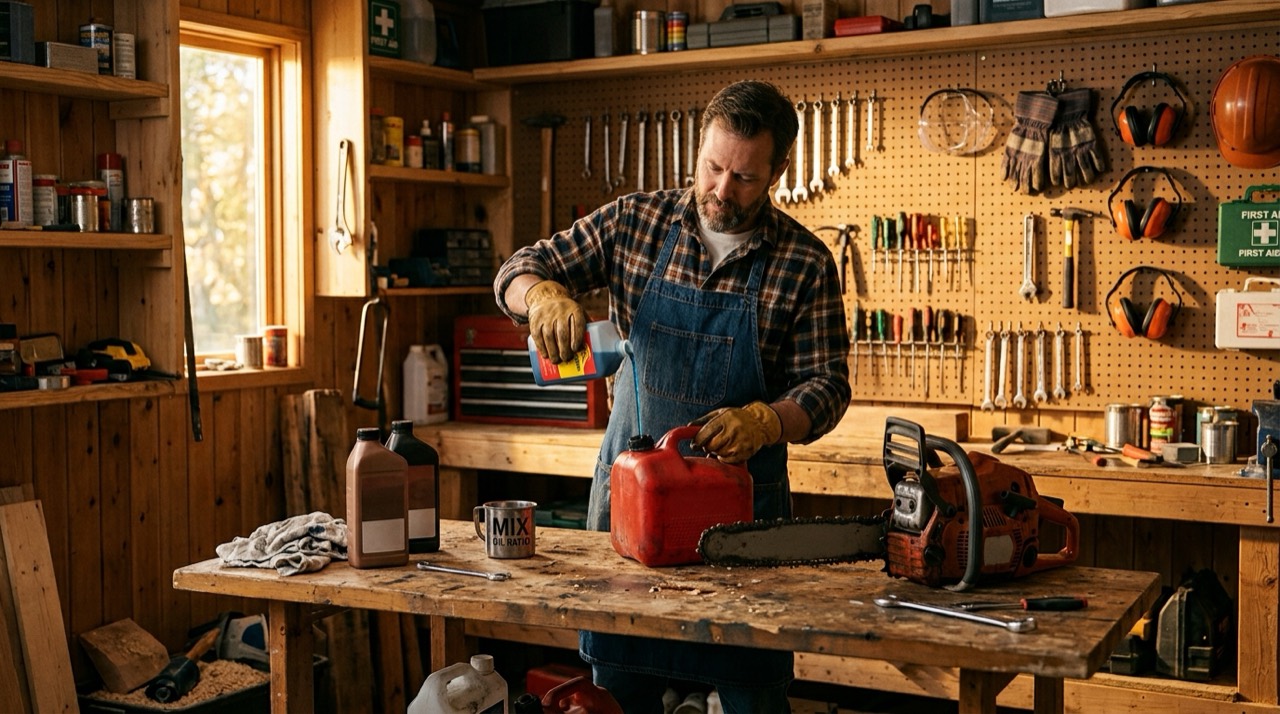
You need surprisingly little to mix fuel accurately, and having the right few items to hand is what turns mixing from guesswork into a repeatable routine. Gather the following before you start:
- An approved, sealable fuel can, clearly labelled as two-stroke mix so it is never confused with straight petrol.
- Fresh unleaded petrol, ideally ethanol-free, bought recently from a busy station.
- A quality two-stroke oil rated JASO FD or ISO-L-EGD, or a matching pre-measured bottle.
- A dedicated measuring cup marked in millilitres or fluid ounces, if you are dosing from a bulk bottle.
- A funnel and a rag for clean, spill-free pouring.
- A permanent marker to note the ratio and mix date on the can.
Keeping this small kit together means you can mix a clean batch in a couple of minutes, outdoors and away from any ignition source. Store the can with the rest of your fuel and oil supplies as covered in the outdoor tool storage guide.
How do you measure the oil accurately?
Measure the oil by the volume of petrol you are mixing, using the ratio chart, and dose it with a marked cup or a pre-measured bottle rather than by eye. Accuracy matters most at small volumes, where a splash too much or too little shifts the ratio noticeably. A worked example makes it concrete: to mix two US gallons of 50:1 fuel you need 2.6 fl oz per gallon, so 5.2 fl oz of oil in total; in metric, five litres of 50:1 needs 20 ml per litre, so 100 ml of oil.
The simplest way to remove arithmetic is to match your batch size to a pre-measured bottle — Stihl, Husqvarna, and Echo sell bottles sized to make exactly one, two-and-a-half, or five units of mix, so you pour the whole bottle and add the stated petrol. If you dose from a bulk bottle, use a cup marked in the same units your chart uses and pour on a level surface at eye height. Mixing a slightly larger round batch and labelling it is fine, provided you will burn it inside about 30 days.
How do you mix the fuel step by step?
Follow these steps to mix a clean, accurate batch:
- Confirm your saw's ratio in the manual, commonly 50:1.
- Measure the correct oil volume for your fuel quantity from the chart above.
- Pour about half the petrol into an approved, labelled two-stroke fuel can.
- Add the full measure of two-stroke oil.
- Add the remaining petrol.
- Cap the can and shake it firmly for 10 to 15 seconds to blend.
- Label the can with the ratio and mix date, and use it within 30 days.
Mix only what you will use in a month, work outdoors away from ignition sources, and wipe up any spill immediately.
What are the most common fuel-mixing mistakes?
Most mixing failures come from a handful of repeated errors, and knowing them makes them easy to avoid. Each one either shifts the ratio or lets the fuel spoil, and both show up as hard starting or poor running. The usual culprits are listed below:
- Mixing straight into the saw's tank instead of a can, so the first fuel through the engine is under-oiled.
- Guessing the oil by eye rather than measuring, which drifts the ratio rich or lean.
- Using month-old ethanol petrol that has already absorbed water and started to separate.
- Forgetting to shake the can, leaving oil pooled at the bottom.
- Topping a half-used can of old mix with fresh petrol and losing track of the ratio and age.
- Mixing far more than you will burn, so the surplus goes stale before it is used.
The fixes are the mirror image: always mix in a can, always measure, always label with the date, and mix small. These habits keep the carburettor clean on the saw and on every other two-stroke tool in the shed.
How do you fix a saw that ran on the wrong mix?
Stop the saw immediately, work out which way the mix was wrong, and correct it before more fuel goes through. If the saw was run on straight petrol or a badly under-oiled mix, do not keep running it — the risk is a seized piston. Take these steps to recover:
- Stop cutting and switch the saw off at once.
- Drain the tank fully into an approved container for disposal.
- Refill with correctly mixed fuel at the maker's ratio.
- If the saw ran lean or on straight gas, have it checked before hard use, as internal scoring may already have started.
- If it merely ran rich, expect smoke and a fouled plug — clean or replace the spark plug and run a correct mix through.
Persistent over-oiling may also need the muffler and exhaust port de-carbonised over time. When in doubt after a straight-gas mistake, a quick inspection is far cheaper than a replacement engine, and the chainsaw maintenance guide covers the checks involved.
How should you store mixed fuel safely?
Store mixed fuel in an approved, sealed, clearly labelled container in a cool, shaded, ventilated place away from living spaces, heaters, and sparks. Petrol vapour is heavier than air and highly flammable, so ventilation and distance from ignition sources matter.
For anything longer than a month, add a fuel stabiliser at mixing time, or empty the tank and run the saw dry before storage. Stale ethanol fuel is the number-one cause of spring starting trouble, so end-of-season fuel discipline saves a carburettor clean later. Keep the container topped up rather than half-empty, too, since a large air gap lets more moisture condense into the fuel. For more on keeping a saw healthy between jobs, see the chainsaw maintenance guide and the gas chainsaw guide.